
Voices in the Room
“I Put on an Extrovert Suit”
A first-time PWLE attendee on the NIH PURPOSE conference and the U.S. Association for the Study of Pain (USASP) annual meeting — walking in, what changed, and what he’s bringing home.
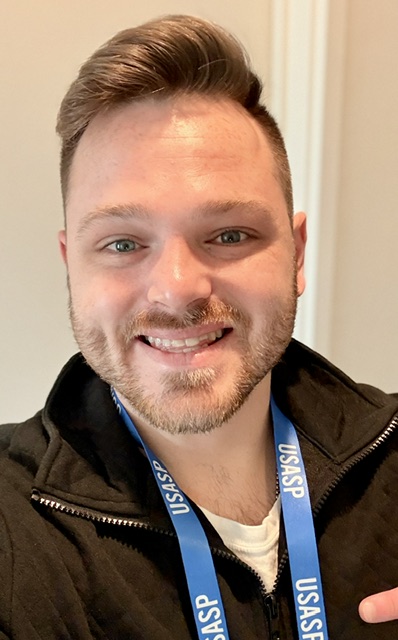
Voices in the Room invites a fellow person with lived experience (PWLE) to describe, in their own words, a room they recently sat in — a conference, an advisory board, a research meeting. Corben Parker is an Army veteran, a nurse, and a person living with complex regional pain syndrome (CRPS) based in Columbus, Ohio. He came into national advocacy through the U.S. Pain Foundation’s Fall 2025 cohort and attended PURPOSE — the NIH HEAL Initiative’s Positively Uniting Researchers of Pain to Opine, Synthesize, and Engage network — and USASP in Philadelphia in March 2026 as his first conferences. What follows is drawn from a recorded conversation, edited for length and clarity, and approved by Corben before publication.
How I Got Here
My name is Corben Parker. I joined the Army in 2019. I was a nurse before that. I’ve been living with complex regional pain syndrome — CRPS — for almost six years. It started with a fractured tibial plateau the X-ray didn’t catch, ligament tests that came back fine, and a military doctor who had me walking on it for five or six weeks until the MRI was finally ordered. By the time orthopedics looked at it, the fracture was eight millimeters depressed. My knee has never been the same.
The CRPS diagnosis came later, after I was out of the service and my physical therapist stopped a session mid-treatment and sent me to the ER by squad. Twenty hours of testing later, the neurologist gave me a name for it. A week after that, while I was sitting in the lobby waiting for my follow-up, I looked the condition up on my phone. The first thing that came up was that CRPS is nicknamed the “suicide disease.”†
That was how I learned what I had — from Google, in a waiting room.
Ketamine is the treatment that’s helped me the most. It works by remapping the neural pathways, desensitizing the nervous system, stopping the central sensitization — the wind-up phenomenon — that has my body perceiving pain in an amplified way. I can walk into the hospital at a ten out of ten and walk out at a zero or a one. It feels like a miracle, but the pharmacodynamics are real. The question I keep asking is: why wouldn’t we want to use this?
In 2022, ketamine became cash-only for me. Inaccessible. In August 2025, a surgeon I’d worked with told me he could refer me to an Ohio State physician who does inpatient ketamine infusions, because inpatient is the only way insurance will cover it. Referral only, case by case, who-knows-who. That’s when I said: something is wrong here. That’s not how healthcare should be. That’s when I went looking for the U.S. Pain Foundation.
I finished their Fall 2025 advocacy program in November. Two weeks later I was on the phone with Senator Husted’s office in Ohio, talking about ketamine access for veterans. By March I was in Philadelphia at my first conferences.
Walking In
I arrived on Sunday and didn’t really know what I was walking into. I checked in, got up to my room, sat down, took a breath. I walked around Philadelphia. Then I looked at Monday’s PURPOSE agenda and decided there were things on it I wanted to see.
Monday morning I got lost. By 8 a.m. I was sitting on a bench by a check-in table with two researchers and another PWLE from D.C. who’d been a researcher herself years ago. We figured out where we were supposed to be and walked over together. I walked into the room around 8:30, looked around for a familiar face, and saw Tom Norris at a table with a few researchers. I went over, said hi, introduced myself to the rest of the table.
I didn’t feel out of place. I felt different. I wasn’t there as a researcher or a scientist or a clinician. I was there as a patient. As myself. And I wasn’t entirely sure how to introduce that — there wasn’t a script for it. But there was someone at the table I already knew, and that gave me a way into the other ten people.
The first PURPOSE presentation I sat through was someone talking about their science who was also a person with lived experience. Seeing that on the stage — someone who was both — was a wow moment for me. Before I walked into that room, I thought conferences were for medical professionals. That was the picture in my head. Seeing that patients are actually on the ground at these things, in the program, on the stage, reframed it for me. Patients are part of healthcare. Patients are part of conferences.
USASP felt the same way — inclusive, grateful to have patients in the conversation. I never felt awkward, never felt like I was in a room I wasn’t supposed to be in.
That said: I was aggressive about being there. Aggressive to learn. Aggressive to be seen. There was a burning desire in me to have conversations with the researchers in that room, and I knew they might not start the conversation. So I had to. If someone walked past, I introduced myself. Every opening, I took.
If you’re an introvert, you have to put on an extrovert suit to go to these conferences.
What Changed
Before I walked into PURPOSE and USASP, my picture of patient engagement was honestly pretty thin. I knew patients could advocate — I’m a nurse, I advocate for patients every day at the bedside. What I didn’t fully see was patient engagement at the system level. Patients in the room where the research gets designed. Patients in the room where the policy gets written.
By the time the four days were over, my optimism had grown. I saw the possibilities. I saw what it could look like over the next twenty years if patients are consistently included — not just as participants, not just as survey respondents, but as partners. The word partner matters here. A patient partner is not a patient who fills out a form. A patient partner goes A to Z and beyond with the researcher — building, developing, monitoring, concluding, disseminating. That’s a different role, and it’s the role I now think the system needs to make room for.
Patient engagement is not filling out a survey for 20 minutes. It’s sitting around a table talking about how the policy actually affects the end user.
Every time I leave a hospital visit, I get a survey. That’s not engagement. Engagement is sitting around a table and talking about how a policy actually affects the end user. That’s the version I saw at these conferences, and that’s the version I want more of.
Where does the push come from? I think it has to come from researchers and from institutional review boards (IRBs) — the people who decide what a study looks like before it ever goes to a patient. It can start with patients knocking on doors. But the decision to actually open the door, that has to come from the other side. And it can’t be conditional on whether there’s funding for it. If patient engagement is important to you, you find a way.
PCORI, the Patient-Centered Outcomes Research Institute, clearly values it. USASP clearly values it. NIH is a different question — 27 institutes, each with its own culture. The honest answer is that it depends on whether the program officer asks the question — “Have you considered patient engagement?” — when the grant is being reviewed. And whether the director above them is willing to say: this is how we are going to do it. Not a suggestion. A direction.
If all we can do is suggest, how are we going to make progress?
What I’m Bringing Home
What I keep coming back to from those four days is how high the bar got set. It was an incredible four-day experience, and for it being my first conference ever, it set a pretty high bar for what to expect in the future. I left more optimistic than I walked in. The wall I was bracing for wasn’t there — at least not at PURPOSE and USASP.
Here’s what I wish more clinicians and researchers knew: patients are willing to engage. There are patients out here who are willing to put in the time to make changes and to develop good things. Not just fill out a survey at the end of an appointment. Real engagement. A seat at the table when the policy is being written.
What I’m going to do differently: I’m going to keep starting the conversations. I’m going to keep reaching out. If there’s a researcher or a group doing work on something that touches my advocacy — ketamine access, CRPS, rare disease, central sensitization — I’m going to look them up, find an email, and send a clear, concise note. Be vulnerable. Say what I’m asking for. Say whether I’m looking for a relationship, a mentor, a chance to share what I know.
If a graduate of the U.S. Pain Foundation’s advocacy program called me tomorrow and asked whether to attend PURPOSE or USASP next year, here’s what I’d ask them: Are you willing to put in the work? Are you willing to do the research on your own? How involved do you want to be? Because the doors are open. The conversation is there. But it doesn’t come to you. You have to walk through.
One last thing I keep thinking about. There’s a selflessness piece to advocacy that I didn’t fully understand until I was in those rooms. My path didn’t start with what would help me. It started with what would help everybody. And along the way it helps me too — but the order matters. If you’re going to do this, you’re going to do it for everyone.
Patients are part of healthcare. Patients are part of conferences. Once you’ve seen that up close, you can’t unsee it.
I walked in without much of a picture, I’m walking out with a direction – because I was never afraid to step forward, speak up, and be unapologetically extroverted
A connection worth naming. Corben Parker serves on the selection panel for Better Together Recognitions, a PWLE Voices program I co-chair. Nominations for the current cycle are open as this issue publishes. He takes no part in any decision affecting himself, and his place in this issue was never a panel matter. I would rather you hear that from me than notice it later.
Voices in the Room is a recurring feature of PWLE Voices. Pieces are first-person, edited for length and clarity, and reviewed by the contributor before publication. The views expressed are those of the contributor and do not necessarily reflect the views, policies, or positions of the U.S. Pain Foundation, the American Chronic Pain Association, the U.S. Department of Veterans Affairs, or any federal program or committee on which the editor serves.