


Meet a Fellow PWLE
Getting to Know Sharon Waldrop
Nearly thirty years after a doctor threw a brochure at her and left the room, Sharon runs the support group, the awareness day, and the podcast she once needed to find.
Sharon and I sit on the same committee. We are both members of the People With Lived Experience committee of the U.S. Association for the Study of Pain, and I also co-chair the association’s Clinical Care and Patient Advocacy special interest group — an unpaid, volunteer role. We met last year at ICON, the International Conference on Nociplastic Pain. That is why this profile ends by pointing you toward an organization I help run. Read it knowing that. — Tom

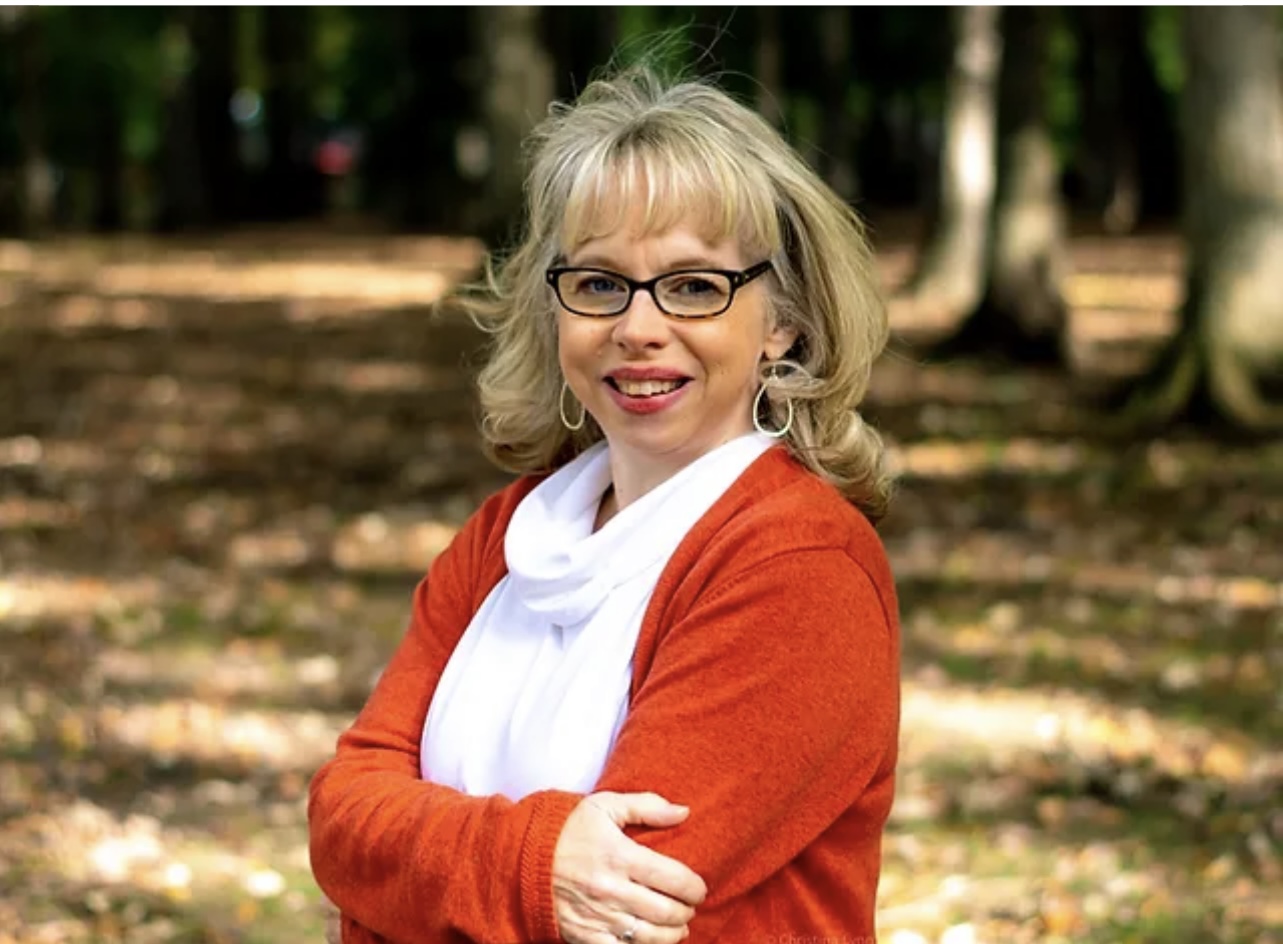
Ask Sharon Waldrop to describe herself and the first word she reaches for is curious. “I could have opera on one minute and country the next,” she says. “It’s all over the map, depending on what my vibe is.” She loves to learn, loves to travel — “if I could do that full time, that’d be awesome” — and loves her family: her husband Mark, two sons in their early twenties, and Milo, a parrot with the brain of an Amazon and a vocabulary to match. Midway through our conversation, Milo landed on her shoulder and asked, politely, for attention. He uses his words appropriately. “He’s my joy,” she says.
Curiosity, it turns out, is also how she survived.
A brochure and a prescription
Sharon was 24, working in public relations, riding her bike ten miles a day, when a bout of bronchitis knocked her down and she never got well again. Her diagnosis came unusually fast — and unusually badly. “The doctor came in the room, looked at me, said, ‘You have fibromyalgia, you just need to learn how to live with it.’ He threw a brochure from the Arthritis Foundation at me and a prescription for antidepressants and left the room. There was no discussion. I’m not exaggerating.”
He also told her to go on bed rest — advice she now calls the biggest mistake he could have made for someone who loved exercise. Within weeks she had spiraled. She stopped sleeping. She couldn’t walk from her bedroom to the kitchen without lying down on the floor.
The patient brochure he threw at her is what saved her. Her mother called the Patient Advocacy Organization, which suggested warm-water exercise. “That pool changed my life,” Sharon says.
The first fibromyalgia support group she visited nearly finished what the diagnosis had started. At 24, she was by far the youngest person in a room where most people used wheelchairs and walkers. “I cried all the way home. I thought, that’s going to be my life. I’m never going to get married, never going to have kids.”
Then she found her way to an international conference of researchers, clinicians, people living with the condition, and support group leaders. “It really saved me. These people knew what it was. They were handling it.” She came home with information that genuinely helped her health — and a thought she couldn’t shake: this is crap, there are other people like me, I need to tell other people.
Seventy people on the first night
In 1997, one year after her diagnosis, the Arthritis Foundation trained her to start her own support group. She told her friend she’d be thrilled if ten people showed up. Seventy came. “I had people coming up to me, crying, thanking me. I didn’t know what I was doing either. I told them, hey, I’m new to all this — we’re going to figure it out together.”
That group became the Fibromyalgia Association, the volunteer-run nonprofit Sharon still leads. Next year the organization turns thirty. The monthly support and education group has met continuously since 1997. Fibromyalgia Awareness Day, the annual conference she founded in 2001, just marked its 25th year. Along the way she has brought legislators to lunch at the state Capitol in Lansing, gone through an intensive disability-advocacy training called Michigan Partners in Policymaking, and lobbied in Washington, D.C., in the years when walking itself was hard.
When the pandemic pushed everything online, the Support & Education Group Sharon had built in Michigan suddenly began reaching people across the nation, and beyond. Eventually she dropped “of Michigan” from the organization’s name to reflect its growing reach. While her advocacy work had already extended throughout Michigan and beyond, becoming a national organization wasn’t something she had initially set out to do. What she has been intentional about is making sure growth is sustainable. “I’ve always wanted what we build to be sustainable and to grow in a way that allows us to continue providing the core programs people have come to rely on, including the Support & Education group and Awareness Day.
The alphabet soup
Five years ago, Sharon added a credential to the lived experience: she became a National Board Certified Health & Wellness Coach, with additional certifications in pain management coaching, lifestyle medicine, and menopause lifestyle medicine. Part of her initial reasoning was strategic. “I felt like I needed some kind of alphabet soup after my name,” she laughs. But the training and board certification also give her an evidence-based coaching skill that complemented her decades of lived experience and advocacy.The credential opened the door to PAINWeek, where she delivered continuing medical education to physicians alongside Dr. Ginevra Liptan, a doctor who also lives with fibromyalgia. The two co-host The Fibro Show, a YouTube program approaching 25,000 viewers.
You can come, but don’t talk to anybody
Sharon’s first brush with the research world set a low bar. Years ago, she and a group of other people with fibromyalgia were invited to a major international pain research meeting — with conditions. “They said, you guys get to come, but you can’t talk to anybody, and you cannot ask any questions. You’d walk by researchers you recognized, say hi, and just have to keep walking.”
She went along with it then. She wouldn’t now. Today Sharon serves on the People With Lived Experience committee of the U.S. Association for the Study of Pain, and she’s watched patient engagement move from the end of the research pipeline toward the beginning. “Even just how a study is designed and what will be required of participants— is that something one of us could actually do during the study? Is it something you can do in real life? Without having a patient in the room, how could you know that?”
She’s candid that this lane is new to her, even after three decades of advocacy. “I feel like I’m catching up, learning the terms, so I can contribute in a helpful way.” But she’s clear on why it matters — and clear that people with pain bring more than their diagnoses. “We’ve all got skills. I wear the board-certified health coach hat, I wear the PR and communications hat; Everybody has a skill set.”
One percent better
Ask what she’d say to someone newly diagnosed, and Sharon doesn’t hesitate. “Have hope. Getting better is possible. And getting one percent better matters.” That’s how she did it: anything that made her one percent better went in the toolbox, and the percents added up — a chair lift once installed in her home is long gone, and her bucket list since diagnosis includes skydiving and rock climbing. “It is daily management. It is a lifestyle. But the people I’ve seen get better never gave up.”
And the thing she wants this community to hear most is where she landed at the end of our conversation. “Honestly, the best part of my illness is the people I met. I would have never met you. I wouldn’t have met the people in my group. I have friendships I would have never had. I believe in looking for the silver lining — it’s there somewhere, if you look hard enough.”
— Tom
The views, positions, and recommendations expressed in this article are based on my personal experiences. They are solely my own and do not necessarily reflect the views, policies, or positions of the American Chronic Pain Association (ACPA), the Patient-Centered Outcomes Research Institute (PCORI), or any federal program or committee on which I serve. AI was used for editing and organizing; final text is my own.